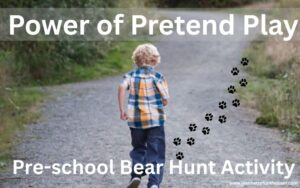
If you’ve ever tiptoed through tall grass, splashed through pretend rivers, or crawled through a “cave” in search of a bear, you know how magical pretend play can be for preschoolers.
One of our favorite traditions at Snicker-Doodles Pre-K Market is the Bear Hunt—an adventurous blend of imagination, movement, teamwork, and exploration that goes far beyond fun. It’s pretend play with a purpose.
Let’s dive into the why behind pretend play and how activities like a Bear Hunt nurture BIG skills for our littlest learners.
🌟 1. Imagination & Creativity
Pretend play fuels a child’s creativity and symbolic thinking—essential foundations for early literacy and problem-solving.
When preschoolers:
- Pretend the carpet is a river…
- Imagine crawling through a cave…
- “See” a bear hiding in the trees…
They are developing symbolic representation—the ability to let one thing stand for another—which supports abstract thinking and later reading comprehension.
Key Benefits:
- Develops storytelling and expressive language
- Encourages open-ended thinking
- Sparks curiosity and role play
Try this during your Bear Hunt:
- Ask children to describe what they see or feel (“What does the mud feel like?”)
- Invite them to create their own obstacle (“Oh no! A lava pit!”)
- Encourage retelling of the story in their own words
📘 Illinois Early Learning Standards Tie-In:
- Goal 9.A.ECa: Recognize and name common emotions
- Goal 10.A.ECb: Use imagination to create a story or play
- Goal 25.A.ECa: Express self through movement and imaginative play
🏃 2. Gross Motor Development
Bear hunts = big body movements. From tiptoeing past the bear to crawling under “branches,” this adventure gets every muscle group involved.
Physical Skills Developed:
- Balance
- Coordination
- Core strength
- Motor planning
Movement Ideas:
- Crawl under tables (cave)
- Walk across a balance beam (log bridge)
- Jump across floor mats (river stones)
- Tiptoe quietly (don’t wake the bear!)
- Run back to “home base” at the end
📘 Illinois Early Learning Standards Tie-In:
- Goal 19.A.ECa: Engage in active play using gross-motor skills
- Goal 19.A.ECb: Demonstrate body coordination through movement
🤝 3. Teamwork & Cooperation
Bear hunts often happen in groups—and that creates rich opportunities for social-emotional development.
Children Learn To:
- Take turns and share ideas
- Work together toward a goal
- Practice leadership and following
- Listen actively and contribute to group decisions
Facilitate Peer Interaction By:
- Assigning group roles (leader, map holder, binocular scout)
- Encouraging joint decision-making (“Should we go around or through the river?”)
- Using call-and-response chants to unify the group
📘 Illinois Early Learning Standards Tie-In:
- Goal 31.A.ECb: Engage in cooperative group play
- Goal 30.C.ECa: Exhibit eagerness and curiosity as a learner
🧠 4. Problem-Solving & Critical Thinking
Pretend play introduces challenges that children must navigate using imagination and logic.
Example Challenges:
- The cave is dark—how can we explore safely?
- A pretend river blocks the path—what now?
- The bear is too close—what should we do?
These moments help develop early STEM skills and executive functioning.
Encourage Thinking With Prompts Like:
- “How can we get across without getting wet?”
- “What could we use for a flashlight?”
- “If we’re lost, what do we need to find our way back?”
📘 Illinois Early Learning Standards Tie-In:
- Goal 11.A.ECc: Plan and carry out simple investigations
- Goal 12.D.ECa: Explore simple tools and machines
💪 5. Emotional Resilience
Pretend play lets children explore emotions in a safe, supportive way.
During a Bear Hunt, they might feel:
- Nervous in the dark cave
- Excited to find the bear
- Scared during the run back home
These Emotional Moments Help Kids Learn:
- It’s okay to feel afraid
- They can try again and be brave
- Emotions are manageable with support
How to Support Emotional Growth:
- Acknowledge feelings during play (“It’s a little spooky in this cave!”)
- Model calming strategies (“Let’s take a deep breath before we go in.”)
- Celebrate bravery and persistence
📘 Illinois Early Learning Standards Tie-In:
- Goal 1.C.ECa: Demonstrate ability to manage emotions
- Goal 2.D.ECa: Begin to understand and follow rules
🧺 Bringing the Bear Hunt to Life in Your Classroom
At Snicker-Doodles, our Bear Hunt is more than a story—it’s an event.
Here’s how we bring it to life:
✔️ Before the Hunt
- Read We’re Going on a Bear Hunt by Michael Rosen
- Introduce vocabulary (swishy-swashy, squelch-squerch)
- Pre-teach using a social story (perfect for all learners)
- Practice each movement ahead of time
- Send a note to families inviting volunteers
✔️ Materials to Set the Scene
- Blanket tunnel = dark cave
- Blue streamers = river
- Brown paper bags = mud pit
- Cotton batting or crumpled paper or bubbles= snowstorm
- Leaf piles = forest
- Paper binoculars = exploration tools
- Map visuals = early geography & sequencing
✔️ During the Hunt
- Use a chant or call-and-response to stay together
(“We’re going on a bear hunt… we’re gonna catch a big one…”) - Pause to describe what you “see,” “hear,” and “feel”
- Include unexpected surprises (a bear paw print!)
✔️ After the Hunt
- Reflect with group discussion: “What was your favorite part?”
- Retell the journey using pictures, props, or drawings
- Make a class book: Our Bear Hunt Adventure
- Use photos to help students recall the sequence
🎒 Bonus Learning Opportunities
Pretend play activities like Bear Hunts can also strengthen:
✅ Language & Literacy
- Vocabulary building (mud, cave, snowstorm)
- Story sequencing
- Descriptive language
- Rhyming and rhythm through chants
✅ Math Concepts
- Ordinal numbers (“first we crossed the river…”)
- Spatial language (over, under, through)
- Patterning (repeated refrains)
✅ Science & Nature
- Animal habitats
- Weather vocabulary
- Exploring natural materials
✅ Social-Emotional Themes
- Empathy (“What would the bear feel if we woke it up?”)
- Self-regulation (taking turns, waiting, listening)
- Following directions in sequence
📚 Pretend Play IS Learning
Pretend play isn’t just “extra” time—it’s essential. Through imagination, preschoolers are:
- Practicing real-life problem solving
- Exploring feelings and friendships
- Building strong, capable bodies
- Developing creativity and flexible thinking
And all of that can happen on a pretend Bear Hunt.
Whether you’re teaching in a classroom, at home, or in the great outdoors, pretend play opens the door to meaningful learning across every domain of early childhood development.
✨ FREEBIE: Bear Hunt Social Story & Visuals
Want to go on your own Bear Hunt adventure?
Get our Bear Hunt Social Story and Visual Support Set—a printable freebie designed to help all learners prepare for the big day.
Perfect for:
- Practicing sequencing
- Supporting transitions
- Building confidence and excitement
Let the adventure begin!